Last night I had the pleasure of attending a lecture/performance demonstration at the Lincoln Theatre. Assistant Professors Crystal Michelle Perkins and Dr. Nyama McCarthy-Brown gave us an inside look into their research areas and the influences of identity, life experiences, spirituality, community involvement, and race interact with their creative and scholarship practices. The night began with both women performing a small duet together. Seeing them both perform in their movement styles allowed me to see a new layer of them that isn’t always seen in the classroom/studio setting. Both women moved with grace and drew me into the intimate duet.
After the duet finished Dr. McCarthy-Brown showed a small video about the creative work she does with her son that speaks to the themes of being a single Black mother raising a Black son. Her work focuses closely on her relationship with her son and the exploration his life growing up as a Black man in America. The scholarship side of Dr. McCarthy-Brown’s research is about inclusive pedagogy for a diverse world. She read an excerpt from her book speaking to the personal experiences she faced in the dance studio and how they shaped her outlook to learning dance. I thoroughly enjoyed how open and vulnerable she made herself in order to speak on these topics. In my opinion, someone showing that they have dealt with certain problems makes it easier for others to connect with them. Dr. McCarthy-Brown allowed us into her life experiences and creative process so we could understand the intentions and meanings behind her research.
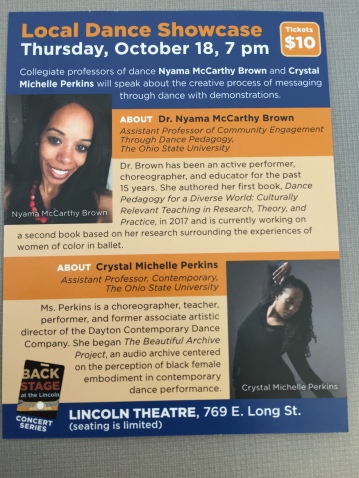 Next Professor Perkins presented two excerpts of choreographic work she created for Dayton Contemporary Dance Company. Along with video presentations of the work, she had two company members demonstrate some of the movement to give us background information on specific gestures, hand positions, and musical choices. I’ve been working with Professor Perkins this semester for the 50th Anniversary Dance Concert at The Ohio State University, so we’ve conversed about some of the African diaspora influences in her work. However, being able to see the physical representations of it through the company members and the films shown I was able to clearly see those references and how they all work together.
Overall, I enjoyed attending this lecture/performance demonstration. This showcase allowed me to visually see the creative and academic work that my professors are making. This experience has built upon my idea of research and all the possibilities within it. Research isn’t just limited to academic writing, it involves choreographic works, film-making, community outreach, and so much more. The many choices and paths that can be taken in the world of dance makes me love it even the more.
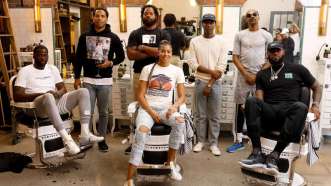 The underlying themes of identity and community were prevalent throughout each episode. The barbershop in the Black community is a place of comfort and sanctuary to speak whatever the heart desires. This show created a safe space and I connected with that idea. As an artist I want to facilitate spaces of vulnerability that are welcoming to a plethora of ideas and issues that can be discussed. This show was a pleasure to watch and I can’t wait for the upcoming episodes.
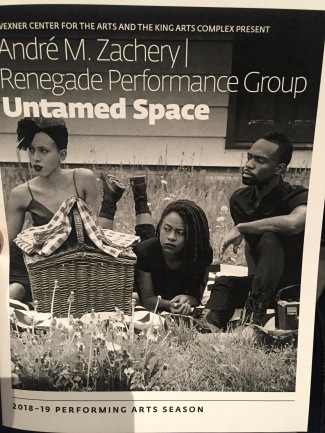 The performance of Untamed Space by Renegade Performance Group was a melting pot of technology, music, movement, and wonder. The melodies and rhythms flowed from the music and was transported into the projections displayed on the scrim and into the bodies of the dancers. Along with responding physically to the music, the dancers created their own sounds becoming instruments themselves. Fusing the technological effects with specific songs related to spirituality and the Black culture, brought the audience into the world of Afrofuturism. The choreography of the show was based upon a series of movements that were used throughout. Pairing specific phrases with music that was complimentary enhanced the reception of the movement, while phrases that were linked to contradictory music allowed for mental contemplation and an acceptance over time. With the bulk of the movement being floor-work and using the technique of physical propulsion, the dancers filled the space and music with electric energy that resonated well after the show is over.
 Davianna's Space