The end of my first year of graduate school has come to an end and I’m reflecting on the experiences these last ten months have brought me. I began this journey unsure of myself, my abilities, and my place in graduate school. Transitioning from an undergraduate program to a graduate program was a hard shift, but doubts surrounding my age and professional experiences took a tool on me mentally. Luckily, I was blessed with a cohort that was supportive, and we helped each other through this transition into graduate school. Over this first year I’ve accomplished so much and gained confidence in my artistic practice, and gained lifelong friends.
One major hurdle I’ve overcome this year is my fear of public speaking. Unlike undergraduate classes, most classes are discussion based and require verbal interactions. For me, this format was equivalent to me hanging from a cliff by my finger tips. I felt so exposed and vulnerable every class. I was also nervous when it came to discussing theorist such as Foucault, Butler, and Lepecki (still don’t entirely understand it really). But as the semesters progressed and I became more  comfortable with the class structure, it was easier to engage in conversation. Along with learning to extract the information that is important and relevant to my interests rather than trying to understand Phenomenology in one week. Along with participating in class discussion, we were required to present creative projects which I enjoyed, but also I had to lead the lecture which I absolutely didn’t enjoy before I experienced it. When preparing to lead the lecture I realized I had knowledge and a unique perspective that I could bring to the material. This assurance in myself allowed me to lead both lectures with confidence (and even get a job well done from my professor!). Having these moments to lead and put my ideas in the forefront assisted me when I was a panelist at the International Association of Blacks in dance conference. When myself and fellow colleagues spoke about our insight into graduate school as black women, I wasn’t nervous at all. Reflecting back, I’m appreciative of the times I’ve been pushed out of my comfort zone over the course of this first year. Without that guidance, I wouldn’t have been able to develop my voice in or beyond the classroom.
Over the course of this year I’ve had the opportunity to perform, make, and collaborate with some awesome humans. I began the year in a work made by Crystal Michelle Perkins, Lush Departures, which challenged me physically and mentally the entire process. Working with her reinforced my interest in community building within the making process, as well as my love for rigorous big dancing. My participation in this work led me to be rehearsal director for the excerpt of the work performed at the International Association of Blacks in dance as well as working closely with Crystal (SHE IS GOALS). I was also able to perform a collaborative study from a composition class in the Winter Concert. As well as collaborating with two 2nd year MFA students beginning the process of their thesis projects. My year has been jammed packed, but I’ve enjoyed every opportunity to work creatively with professors and fellow graduate students(also helps me think about what my project may be, yikes!)
With the knowledge I’ve gained in the many facets of this graduate school journey I’ve begun to think more deeply about my research interests. I began my first year heavily focused on the Harlem Renaissance, but now I’m thinking more about the black women/artist place in society and dance. I recently wrote a paper, Reclaiming, Restoring, Reimagining: Cardi B, which was centered around the hyper sexualization of black female bodies in popular culture. I argued that Cardi B uses her body in performance, specifically her music video Money, as a site of personal agency, reclamation of sexuality, and the evolution of black female bodies in popular culture. While writing this paper I realized my passion for the black women, her story, and the ways in which she portrays herself creatively.
As I continue these next two years of graduate school I’m excited to continue to transform as a human and artists. This first year alone has shown me that there are no limits to my success, and I dictate my future. With the next year of grad school new challenges will appear such as project proposals, funding, and just general stress of life. However, being able to see the progress I’v already made, and having the support of faculty, my cohort family, friends, and my partner, the possibilities are limitless.
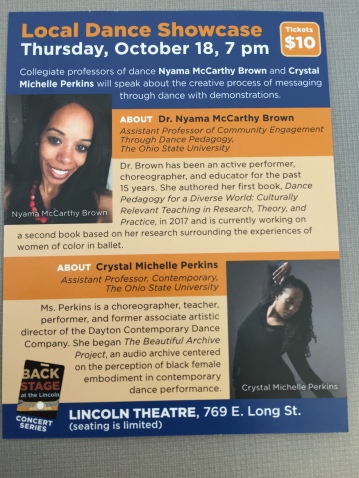 Next Professor Perkins presented two excerpts of choreographic work she created for Dayton Contemporary Dance Company. Along with video presentations of the work, she had two company members demonstrate some of the movement to give us background information on specific gestures, hand positions, and musical choices. I’ve been working with Professor Perkins this semester for the 50th Anniversary Dance Concert at The Ohio State University, so we’ve conversed about some of the African diaspora influences in her work. However, being able to see the physical representations of it through the company members and the films shown I was able to clearly see those references and how they all work together.
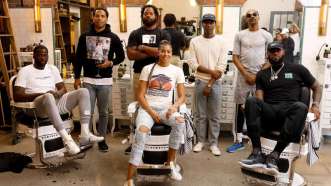 The underlying themes of identity and community were prevalent throughout each episode. The barbershop in the Black community is a place of comfort and sanctuary to speak whatever the heart desires. This show created a safe space and I connected with that idea. As an artist I want to facilitate spaces of vulnerability that are welcoming to a plethora of ideas and issues that can be discussed. This show was a pleasure to watch and I can’t wait for the upcoming episodes.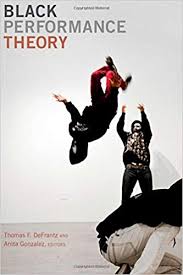
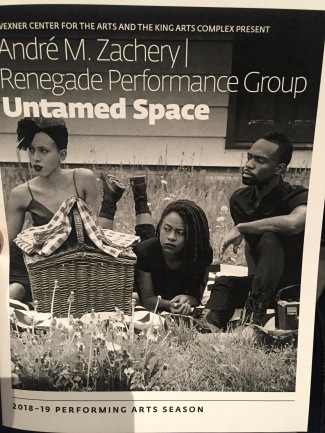 The performance of Untamed Space by Renegade Performance Group was a melting pot of technology, music, movement, and wonder. The melodies and rhythms flowed from the music and was transported into the projections displayed on the scrim and into the bodies of the dancers. Along with responding physically to the music, the dancers created their own sounds becoming instruments themselves. Fusing the technological effects with specific songs related to spirituality and the Black culture, brought the audience into the world of Afrofuturism. The choreography of the show was based upon a series of movements that were used throughout. Pairing specific phrases with music that was complimentary enhanced the reception of the movement, while phrases that were linked to contradictory music allowed for mental contemplation and an acceptance over time. With the bulk of the movement being floor-work and using the technique of physical propulsion, the dancers filled the space and music with electric energy that resonated well after the show is over.
 Davianna's Space